“The role of leadership and business strategy is to promote the integration of sustainability issues at a strategic level, so that they are embedded in organizational development covering strategy, planning, enterprise risk management, and operations. The importance of tone at the top is best captured by the King Code of Corporate Governance for South Africa, which specifically encourages the integration of governance and sustainability into strategy, operations, and reporting of an organization. The philosophy of the King code revolves around leadership, sustainability and corporate citizenship. Responsible leaders direct company strategies and operations with a view to achieving sustainable economic, social and environmental performance.” (Read the publication Sustainability Framework 2.0: Professional Accountants as Integrators, issued by the International Federation of Accountants (IFAC) in March 2011.)
Wednesday, June 29, 2011
Sustainability Framework 2.0: Professional Accountants as Integrators
Monday, June 27, 2011
Integrating the Business Reporting Supply Chain
High-quality business reporting lies at the heart of strong capital markets and sustainable economic growth. All those involved in the business reporting supply chain play a critical role in making business reports more relevant, understandable and reliable. This will enable the various stakeholders who use those reports to make informed decisions with respect to an organization’s social, environmental, and economic performance.
Recent interviews with key business leaders from around the globe capture recommendations on governance, financial reporting, financial auditing, and broader business reporting from prominent preparers, directors, auditors, standard setters, regulators and investors. This report analyzes what, according to interviewees, the various participants in the business reporting supply chain should do to further improve governance and the usefulness of business reports, as well as the preparation and audit of those reports. Unless otherwise stated, the recommendations in this report apply to all organizations and businesses. (For more information, read the March 2011 IFAC report Integrating the Business Reporting Supply Chain.)
Friday, June 24, 2011
IBM celebrates 100 years
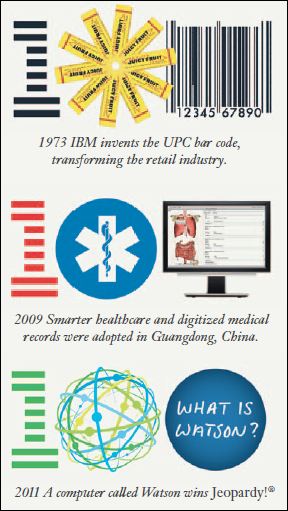
“Of the top 25 industrial corporations in the United States in 1900, only two remained on that list at the start of the 1960s. And of the top 25 companies on the Fortune 500 in 1961, only six remain there today. Some of the leaders of those companies that vanished were dealt a hand of bad luck. Others made poor choices. But the demise of most came about because they were unable simultaneously to manage their business of the day and to build their business of tomorrow. As you read this, IBM begins its 101st year. Today we take a moment to step back and view the longer arc of history. We’d like to share some of what we have learned—sometimes in humbling ways—on our journey so far.” Read the full essay on the IBM 100 website. Explore an evolving collection of stories about the 100 IBM innovations that helped shape the last century. Celebrate IBM’s 100-year history with commemorative memorabilia designed exclusively for IBMers, families and friends.
Wednesday, June 22, 2011
20 Questions Directors Should Ask about Information Technology Security
“The CICA’s Information Technology Advisory Committee developed this booklet to guide Boards of Directors in evaluating information technology (IT) security issues. It should also be of use to other bodies responsible for governance — in particular audit committees and strategic bodies such as IT steering committees, risk management committees, and CEO/CFO controls certification committees. Directors are expected to satisfy themselves that risks potentially jeopardizing the integrity of information, the availability of information and operational systems, the confidentiality of sensitive data, and compliance with regulatory bodies, are identified and reduced or eliminated. This booklet provides questions for Boards to ask senior management as well as the context needed to ask the questions and assess responses. In this document, IT Security (Security) is defined as the protection of data captured, processed, transmitted, reported and stored electronically. IT Security also covers the protection of related components such as application systems, system software, networks and hardware, as well as the supporting people, policies, procedures, processes and organization.” (Read the CICA publication 20 Questions Directors Should Ask about Information Technology Security.)
Labels:
CICA,
IT,
risk and uncertainty,
risk management,
security
Friday, June 17, 2011
Green Gauge
The idea that business organizations have a responsibility to account for their impact on the environment once seemed radical, even eccentric. Now, it is accepted as a mainstream concept – but to put it into practice, corporate reporting will have to evolve dramatically. It’s a challenge to which the accountancy profession must step up, if it is to retain its relevance in the 21st century. As a start, the Sustainability Advisory Group of the Institute of Chartered Accountants of Scotland (ICAS) has launched a dedicated section on the institute’s website providing links to a number of useful resources and a template Corporate Social Responsibility Report. (Read the article “Green Gauge” in the May 2011 issue of CA Magazine (Scotland) online.)
Subscribe to:
Posts (Atom)