Showing posts with label corporate culture. Show all posts

Tuesday, March 20, 2012

GRI / Deloitte XBRL Taxonomy for Sustainability Reporting

XBRL stands for eXtensible Business Reporting Language. It is one of a family of 'XML' languages and is machine readable. Use of XML language allows sharing not only the data, but also the format that is used for presenting the data. Machine readable means that computers can recognize various elements of the report and process it without manual labor. Computers can recognize the information in an XBRL document, and select, analyze, store, and exchange it with other computers. XBRL data is set out in taxonomies – data classifications that are defined by industries and organizations for their reports and communications. XBRL information can be presented automatically in a variety of ways.

The Global Reporting Initiative (GRI) Taxonomy, developed in collaboration with Deloitte, is one of the first XBRL taxonomies for sustainability reporting. It will help investors, auditors and analysts to access information in sustainability reports faster, and more simply. An XBRL taxonomy is an industry-specific categorization scheme that defines and 'tags' data in relation to its purpose, framework or outline. It enables users to uniquely tag and identify individual detailed reporting elements which can be easily shared electronically. In the case of the GRI Taxonomy, data can be tagged following the GRI Guidelines.

The new GRI Taxonomy enables organizations to tag their sustainability data in reports. This will help report users – including regulators, investors and analysts – to find and analyze sustainability information. Organizations can benefit from a well-defined structured format for collecting and disseminating sustainability information. It enables reporters, analysts, regulators and others to exchange sustainability data electronically and inform stakeholders with consistent and high quality information.

For more information, see the GRI frequently asked questions webpage. Reporters who use the GRI Taxonomy are asked to participate in the Voluntary Filing Program.

Thursday, September 22, 2011

Mobile insecurity

The proliferation of mobile computing has brought on a number of challenges, specifically around security issues. Smartphones are repeating a pattern witnessed in the 1980s with desktop computers. They flood into the corporate fold without any rational plan. And very often, they are introduced by employees who can’t resist the status statement these devices make. The greatest obstacle to security is the users themselves. People believe nothing of value resides on their device, yet much can be used for identity theft, intellectual property theft or espionage. Everyone likes these devices for the immediacy and convenience, and don’t want to be bothered with security barriers, especially passwords. This is why many users deactivate the password protection, which to begin with is very rudimentary and requires only a four-digit PIN identification. In a regular notebook, that would never be accepted as security. To learn more, read the article “Mobile insecurity” in the September 2011 CAmagazine online.

Tuesday, July 12, 2011

Transocean: No Apologies Over Gulf Oil Spill

"Fourteen months after the Deepwater Horizon drilling rig exploded 50 miles southeast of Venice, La., killing 11 men and setting off the largest offshore oil spill in U.S. history, Transocean (RIG), the company that owned and ran the ill-fated 32,600-ton vessel, finally issued its official account of what happened and why. It produced a report on June 22 of no fewer than 854 pages, divided into two volumes, and spared no detail. The bottom line, though, isn’t complicated:It was BP’s (BP) fault." (Read the full story "Transocean: No Apologies Over Gulf Oil Spill" at Bloomberg Businessweek online.)

Friday, June 24, 2011

IBM celebrates 100 years

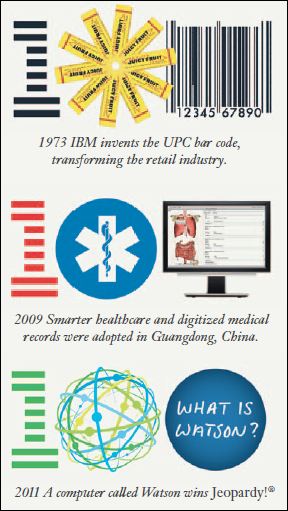
“Of the top 25 industrial corporations in the United States in 1900, only two remained on that list at the start of the 1960s. And of the top 25 companies on the Fortune 500 in 1961, only six remain there today. Some of the leaders of those companies that vanished were dealt a hand of bad luck. Others made poor choices. But the demise of most came about because they were unable simultaneously to manage their business of the day and to build their business of tomorrow. As you read this, IBM begins its 101st year. Today we take a moment to step back and view the longer arc of history. We’d like to share some of what we have learned—sometimes in humbling ways—on our journey so far.” Read the full essay on the IBM 100 website. Explore an evolving collection of stories about the 100 IBM innovations that helped shape the last century. Celebrate IBM’s 100-year history with commemorative memorabilia designed exclusively for IBMers, families and friends.

Wednesday, March 9, 2011

Smarter Evidence and Discovery Management

"There is no question that the influence and role of eDiscovery in litigation in Canada continues to develop. While eDiscovery has been a fixture in the US for many years, there has been a slower, pragmatic and perhaps sensible approach to the disclosure of electronic documents in this country. However, as documents are now overwhelmingly formed and maintained primarily in electronic form, it is acknowledged that eDiscovery has arrived in Canada and is here to stay." Visit the KPMG website and read the publication Smarter Evidence and Discovery Management.

Friday, October 8, 2010

IBM Global CFO Study 2010

The 2010 IBM Global CFO Study – involving more than 1,900 CFOs and senior Finance leaders worldwide – provides the largest window into the CFO mindset during the worst economic downturn in decades. Surprisingly, cost reduction was not at the top of their agenda. Instead, CFOs ranked "providing inputs into enterprise strategy" as most important. CFOs told us their role as strategic advisor is broader and more important than ever. More than 70 percent play a critical role in enterprise risk mitigation, business model innovation and selection of the key metrics linking performance to strategy execution. The pressure to help the business make all manner of decisions better, faster and with more certainty is intense. Read The New Value Integrator: Insights from the IBM Global Chief Financial Officer Study.

Tuesday, April 20, 2010

What would a world-class innovator do?

As we come out of the economic downturn into a hopeful recovery, more organizations are focusing on what they need to do next. My advice to them is to behave like a world-class innovator. And what exactly do world-class innovators do that other organizations don’t? Here’s a rundown... (Read the article What would a world-class innovator do?  by Jim Carroll in the April 2010 issue of CAmagazine online.)

Friday, February 26, 2010

5 Potential Business Uses for the iPad

Does Apple’s iPad tablet have a place in the work setting? Does it provide value that a computer or an iPhone doesn’t? Should tablets be purchased for employees? A recent article explores a few practical business cases for the iPad. It may help in deciding whether to have one as part of the work arsenal. (Read the article 5 Potential Business Uses for the iPad at Open Forum online.)

Wednesday, February 17, 2010

No Social Media Without Strategy

In this online video at Open Forum, John Jantsch, award winning social media publisher, talks about finding strategic ways to deploy social media assets based on an organization's individual brand’s needs. For example, he notes that “Every small business needs to have a blog” and explains why blogs are a great way to share valuable, education-based content with customers. (View No Social Media Without Strategy; You Blog? Who Cares? Customers Will; other clips from this presentation; and the entire OPEN CES experience.)

Friday, January 29, 2010

IBM study - The New Voice of the CIO

IBM has published a study called The New Voice of the CIO. This study explores how chief information officers (CIOs) are successfully growing profits for their businesses and issues they need to address during challenging times. Face-to-face conversations were held with more than 2,400 CIOs from over 75 countries and 15 industries.Key findings include the following:
  • CIOs are increasingly recognized as members of the senior executive team actively engaged in setting strategy, enabling flexibility and change, and solving business problems, not just IT problems.
  • CIOs spend 55% of their time on activities that spur innovation. These activities include generating buy-in for innovative plans, implementing new technologies and managing non technology business issues. The remaining 45% is spent on essential, more traditional CIO tasks related to managing the ongoing technology environment. This includes reducing IT costs, mitigating enterprise risks and leveraging automation to reduce costs elsewhere in the business.
  • CIOs universally acknowledge that some of their most important objectives too often seem to clash: supporting the introduction of new services while avoiding the disruption of existing services; reducing costs while improving services; and balancing the need to influence business strategy with the need to provide top-notch IT support.

Monday, January 18, 2010

Spotlight on Companies’ Response to Fraud

Fraud is on the increase as the global financial downturn takes hold. The Ernst & Young European Fraud Survey 2009 reveals that, despite the increasing risk of fraud, many companies appear to see combating fraud as someone else’s responsibility and place heavy reliance on internal and external audit to prevent and detect fraudulent activities.

Friday, January 15, 2010

Helping Business Owners Advance their Estate Planning

This lively, straightforward discussion by the authors of the Canadian Institute of Chartered Accountants (CICA) Estate Planning Toolkit for Business Owners focuses on the fundamental aspects of estate planning for business owners. Business clients may also access this free program to learn how they can assess where they are and where they’re headed … and how advisory services can help them attain their goals. This Estate Planning Webinar, sponsored by Robert Half Accounting and Finance, attracted over 2500 participants and is now available as an online archived version.

Tuesday, December 15, 2009

Global Risk Management Study

This 2009 Global Risk Management Study by Accenture helps to understand the issues around enterprise risk management in the current economic downturn. The report outlines eight primary lessons to be drawn and the most important keys to achieving high performance through an improved risk management function. The key findings are as follows: 
  • About half believed their company was well prepared to face the economic turmoil.
  • More than 85% indicated that their risk management capabilities needed to change.
  • 42% pointed to the need for better integration of risk, finance and business data.
  • 80% say that poor data quality, inefficient reporting and fragmented systems are increasing the cost of risk management.
  • Risk managers spent only 20% of their time advising business units.
  • More than 70% have increased or plan to increase spending on risk management.

Wednesday, December 2, 2009

Made to Stick: Writing a Mission Statement

Dan Heath, co-author of Made to Stick, speaks about writing meaningful mission statements to lead your business. OPEN Forum gives businesses the tools to connect and collaborate. Exclusive articles, videos, discussion boards and events listings can help businesses get informed and inspired.(View this featured video called Made to Stick: Writing a Mission Statement from OPEN Forum.)

Monday, October 19, 2009

AICPA - Enterprise risk management extends to the board of directors

As policymakers assess the causes of the recent financial crisis, it is clear that improvements must be made in the way that senior executives approach risk management within their organization and the role of their boards of directors in risk oversight. An Audit Committee Brief by the American Institute of Certified Public Accountants (AICPA) provides some insights.

Monday, September 28, 2009

Connecting the Dots Between Leadership, Ethics and Corporate Culture

Many large, progressive global companies are becoming dynamic, organic, decentralized organizations in which leaders use shared values, mission and purpose to gain alignment with corporate goals on the one hand, and commitment to innovation and processes of adaptive change, on the other. Succeeding in this mission depends on the leader’s commitment and support. Would-be progressive leaders will learn how to make the transformation by reading this article, "Connecting the Dots Between Leadership, Ethics and Corporate Culture" in the Ivey Business Journal.

Friday, September 25, 2009

CICA/RBC Business Monitor Webinar

Established in 2007, the quarterly Canadian Institute of Chartered Accountants (CICA) / RBC Business Monitor draws on the strategic thinking and business insight of CAs in leadership positions in industry to provide a view of business trends and economic confidence across our nation. The most recent CICA/RBC Business Monitor survey conducted in Q2 2009 found that optimism regarding the economy has improved, though it is still down from historical highs. The survey also found that corporate profits and revenue are still estimated to decline over the next 12 months, although less than indicated by the previous survey. (Register for the free CICA/RBC Business Monitor webinar on September 29th, 2009. )