Showing posts with label accountability. Show all posts

Thursday, April 26, 2012

20 Questions Businesses Should Ask About Privacy

Privacy has become a significant business risk to organizations that collect, use, retain and disclose personally identifiable information about customers and employees. As a result, business owners, board members and executive management need to assess whether their handling of personally identifiable information complies with numerous privacy laws and regulations. To provide guidance, the AICPA issued a Business Brief on April 10, 2012 called 20 Questions Businesses Should Ask About Privacy. It was prepared by Nancy Cohen, CPA.CITP, CIPP, CGMA, Senior Technical Manager, AICPA Member Specialization & Credentialing.


The questions contained in that Brief were adapted from the guidance booklet, 20 Questions BusinessesShould Ask About Privacy previously published by the Canadian Institute of Chartered Accountants (CICA). They are key questions a business should ask with the aim of understanding privacy risk, implementing a privacy program, managing privacy risk and obtaining privacy assurance.

Friday, April 20, 2012

Does your Annual Report tell your whole value creation story?

According to recent KPMG guidance: “There is growing recognition that the range of issues and opportunities affecting long term business value is much broader than can be reflected in a set of current year financial measures. Annual Reports need to reflect this if they are to support investors’ capital allocation decisions effectively.”

The guidance also notes that: “Integrated Reporting provides a basis to address this by refocusing reporting around an organisation’s business model and operational priorities. The aim is to reflect the critical opportunities and challenges that affect the business - the same issues that management are dealing with on a daily basis within the organisation. Although designed to support the preparation of dedicated Integrated Reports, this approach can be applied by any company preparing an Annual Report - and indeed to other elements of corporate reporting.”

It concludes that: “For executives frustrated by apparent investor short-termism, this is an opportunity to provide a more complete picture of value, how it’s shaped by current and future events, and explain what management is doing to create and preserve it.” To learn more, read the KPMG’s guidance, Does your Annual Report tell your whole value creation story?

Friday, March 30, 2012

Cutting Clutter from Annual Reports

Recently, there has been a drive to cut clutter from annual reports to help users find the information they need and to avoid wasted time for preparers. One impetus comes from the UK Financial Reporting Council (FRC) and the Accounting Standards Board (ASB) report, Cutting clutter: Combating clutter in annual reports, published in 2011. The report defines clutter as “immaterial disclosures that inhibit the ability to identify and understand relevant information,” and “explanatory information that remains unchanged from year to year.”

As the report explains, “Clutter makes it more difficult for users to assess a company’s progress by obscuring relevant information. Due to the time and effort involved in preparing such disclosures, clutter is also a big issue for preparers.” To encourage change, the report includes two short behavioural aids for use by teams preparing and reviewing annual reports. These highlight key questions to consider at the planning phase and during subsequent review. The FRC and the ASB have also developed three disclosure aids – covering governance, accounting policies and share-based payments – to demonstrate what these key areas of the annual report could look like without the clutter.

Friday, March 23, 2012

Integrated Reporting practices of 100 JSE-listed companies

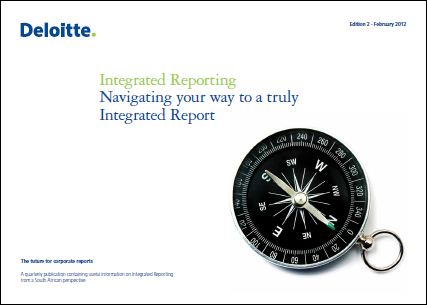
Deloitte has released its second quarterly report on the state of Integrated Reporting in South Africa. The report is called Integrated Reporting – Navigating your way to a truly Integrated Report. It reveals that Integrated Reporting standards have been adopted by more than half of South Africa’s listed companies. Although it is now necessary for these JSE-listed companies to include a statement of compliance with the principles set out in the King Code on Governance Principles (King III) in their annual reports, many companies are still scoring surprisingly low on corporate governance matters.

The publication (which applies to all members of the C-Suite) was prepared by the Deloitte Integrated Reporting and Sustainability team. It contains the key findings of the empirical research conducted on 100 companies listed on the Johannesburg Stock Exchange. The analysis covered 7 subjects, 58 principles and 160 questions seeking to assess actual performance against good practice. The publication includes practical observations on certain topical subjects which appear to be a challenge for companies.

Tuesday, March 20, 2012

GRI / Deloitte XBRL Taxonomy for Sustainability Reporting

XBRL stands for eXtensible Business Reporting Language. It is one of a family of 'XML' languages and is machine readable. Use of XML language allows sharing not only the data, but also the format that is used for presenting the data. Machine readable means that computers can recognize various elements of the report and process it without manual labor. Computers can recognize the information in an XBRL document, and select, analyze, store, and exchange it with other computers. XBRL data is set out in taxonomies – data classifications that are defined by industries and organizations for their reports and communications. XBRL information can be presented automatically in a variety of ways.

The Global Reporting Initiative (GRI) Taxonomy, developed in collaboration with Deloitte, is one of the first XBRL taxonomies for sustainability reporting. It will help investors, auditors and analysts to access information in sustainability reports faster, and more simply. An XBRL taxonomy is an industry-specific categorization scheme that defines and 'tags' data in relation to its purpose, framework or outline. It enables users to uniquely tag and identify individual detailed reporting elements which can be easily shared electronically. In the case of the GRI Taxonomy, data can be tagged following the GRI Guidelines.

The new GRI Taxonomy enables organizations to tag their sustainability data in reports. This will help report users – including regulators, investors and analysts – to find and analyze sustainability information. Organizations can benefit from a well-defined structured format for collecting and disseminating sustainability information. It enables reporters, analysts, regulators and others to exchange sustainability data electronically and inform stakeholders with consistent and high quality information.

For more information, see the GRI frequently asked questions webpage. Reporters who use the GRI Taxonomy are asked to participate in the Voluntary Filing Program.

Friday, February 10, 2012

Integrated Reporting: The New Big Picture

Financial statements are becoming increasingly long and complex with vast tomes of technical detail, requiring a high level of financial expertise to interpret. Complicating matters further, the world has at least two primary sets of standards under which these financial statements are prepared, although a convergence project is underway.

Beyond the financial reporting complexity issues, there is the reality that the tangible assets included in financial statements reflect a steadily diminishing component of shareholder value. Since 1983, when tangible assets represented 83% of market value, to 2009, when they represented only 19%, there has clearly been a change in business models that may not be fully reflected in traditional financial statements. Current financial statements often do not include the “true” value of inputs from, or reliance on, natural capital and other forms of capital. Conditions are ripe for new ideas.

Today, companies produce an increasing array of reports not necessarily linked to the financial statements. Governance issues, including executive pay, are sometimes reported on, as well as some of the impacts of the business on society and the environment. But, these are often reported to different audiences, in different formats and at different times. In this context, the idea of simplifying all the reporting under a consistent banner—integrated reporting—is very attractive.

Just as most of the world has moved steadily toward the adoption of International Financial Reporting Standards (IFRS), the progression toward a single, global, common framework for integrated reporting seems all but inevitable. Less clear, however, is the timing of adoption, which may be affected by a variety of economic, political, social and other factors.

To learn more, read the complimentary article reprint “Integrated Reporting: The New Big Picture” in Deloitte Review, Issue 10, January 2012 (also available online).

Monday, February 6, 2012

Making Corporate Reports Relevant - A Call to Action

The Institute of Chartered Accountants of Scotland (ICAS) has a vision of corporate reporting that is simple: a readable and concise report that tells the story of the business – summarizing the key aspects of performance and prospects – with the detailed disclosures easily available from the company’s website. There is a growing dissatisfaction with a corporate reporting process viewed by many as an exercise in regulatory compliance. Often, stakeholders consider the preliminary results announcement and related presentations to be more relevant and useful than the full annual report. The reform of corporate reporting is now a global priority.

Accordingly, the ICAS has issued a call to action. It states that: “The time for debate and discussion is running out. Quality corporate reporting is fundamental to the operation of effective global capital markets, yet financial statements are increasingly being regarded as inaccessible, incomprehensible and inconsistent with the way in which companies are operated and managed. Our Short Form Report represents a significant improvement in communication with users and offers a next step which could be implemented quickly and with relative ease.”

It also states that: “We believe that the process of producing a Short Form Report following the above principles is a useful one, giving the directors an opportunity to tell their own story. Where this could replace an Annual Review and Summary Financial Statements and ultimately form the basis of a company’s results announcement, we believe it would not be an additional burden but a significant improvement in the delivery of quality corporate reporting. ICAS will now take forward these proposals in the context of the various consultations and the development of integrated reporting, and we will continue to exert our global influence in this critical debate.”

For more information, refer to the ICAS website and read the recently-issued publication Making Corporate Reports Relevant.

Wednesday, January 11, 2012

Canada’s Corporate Reporting Awards program celebrates 60 years of excellence


For 60 years, the CRA has been Canada’s only national program shining a spotlight on Canada’s best corporate reporting models. The program offers publicly-listed companies, and now federal and provincial Crown corporations, a unique opportunity to showcase their commitment to quality corporate reporting. Entrants demonstrate confidence in their reports by submitting them to an independent panel of judges, who are experts in their respective areas.

Fifteen Canadian publicly-listed companies and Crown corporations were recently honoured in Toronto at a gala event that marked the diamond anniversary of the Chartered Accountants of Canada’s Corporate Reporting Awards (CRA).

When the program started in 1941, the focus was the annual financial report. Over the years, it has evolved to keep pace with the capital markets and the expectations of Canadian investors for greater transparency and better information on which to base their investment decisions. Today’s CRA includes separate categories for corporate governance reporting, sustainable development reporting and electronic disclosure. The criteria have helped drive the development of best practices in all these areas, which are now regarded as essential components of the integrated corporate reporting model.

Wednesday, November 30, 2011

PCAOB Concept Release on Auditor Independence and Audit Firm Rotation

On August 16, 2011, the US Public Company Accounting Oversight Board (PCAOB) issued a concept release to solicit public comment on ways that auditor independence, objectivity and professional skepticism could be enhanced.


One possible approach on which the Board is seeking comment is mandatory audit firm rotation, which is explored in detail in PCAOB Release No. 2011-006. However, the Board seeks advice and comment on other approaches as well. Comments should be submitted no later than December 14, 2011. The Board will also convene a public roundtable meeting in March 2012, at which interested persons will present their views. Additional details about the roundtable will be announced at a later date.

Friday, October 14, 2011

PwC’s “To the point: Current issues for boards of directors – Fall 2011”

As the title suggests, “To the point” addresses contemporary issues and is meant to be impactful, insightful and concise. Each quarter, PwC addresses select topics that are of immediate interest to directors. The Fall 2011 edition shares insights on several matters.

Next year's proxy season: The SEC's plan for proxy access was struck down by a US Court of Appeals decision in July, but directors should prepare for the possibility of private ordering proxy access.

A new discussion about mandatory auditor rotation: The idea of mandatory audit firm rotation has resurfaced in a recent PCAOB concept release, and comments are requested on the matter.

Technology in the boardroom: Directors are increasingly using electronic portals and tablet devices to access board materials and books, and the trend is likely to continue.

(Read PwC’s To the point: Current issues for boards of directors – Fall 2011.)

Thursday, October 13, 2011

Amsterdam Roundtable on Integrated Reporting

An Executive Roundtable on Integrated Reporting was recently organized by the International Integrated Reporting Committee (IIRC) and Duisenberg School of Finance in Amsterdam. It was one of a series of roundtables hosted around the world to encourage the exchange of views on Integrated Reporting among leaders in business, investment, civil society, accounting and the standard setting community. The focus was on the Integrated Reporting Discussion Paper, Towards Integrated Reporting – Communicating Value in the 21st Century, which was launched on September 12, 2011.

It was noted that Integrated Reporting is about accountability regarding past financial and non-financial performance and providing insight in how a company aims to create and sustain value for shareholders and other stakeholders. Integrated Reporting only makes sense if it is part of an integrated business strategy. It should not be a data collection exercise, just for the sake of reporting. In addition, legislation has a role to play in creating a level playing field for Integrated Reporting. It should avoid being compliance based and rather be designed along the lines of a “comply or explain” approach. A Summary of the Roundtable Discussion is available online.

Thursday, September 29, 2011

Integrated Reporting: Performance insight through Better Business Reporting

KPMG has issued the first edition of the publication Integrated Reporting: Performance insight through Better Business Reporting. It focuses on the challenge of providing better corporate reporting. Many who read this may not be familiar with the topic but, with the publication by the International Integrated Reporting Committee (IIRC) of its Discussion Paper, it is likely to receive more attention in the future. In the past, KPMG has looked at this as “Better Business Reporting” which captures the essence of the subject.

The first edition provides some background on Integrated Reporting with a series of short articles by some of the firms’ specialists. After a brief summary that explains what Integrated Reporting is, Michael Bray sets out the case as to why senior executives and non-executives ought to be interested.

Thursday, September 15, 2011

The World is Changing – Reporting Must Too

The Integrated Reporting Discussion Paper, Towards Integrated Reporting – Communicating Value in the 21st Century was launched on September 12, 2011. It is available for reading online and as a PDF document. The Paper considers the rationale for Integrated Reporting, offering initial proposals for the development of an International Integrated Reporting Framework and outlining the next steps towards its creation and adoption. Its purpose is to prompt input from all those with a stake in improved reporting, including producers and users of reports. The International Integrated Reporting Committee (IIRC) welcomes general comments on the Discussion Paper, as well as responses to the questions posed. The deadline for submission is December 14, 2011.

Thursday, July 28, 2011

What ethics means in business

On July 15, 2011, the Globe and Mail convened a panel of experts to discuss why companies should act with integrity. The panel comprised: Paul Klein, the founder of Impakt; Don McCreesh of Imagine Canada; Andrew Wilcynski, director of cause marketing for Telus; and Ben Packard, VP of global responsibility with Starbucks. Watch the video on What ethics means in business. Also, view related videos on corporate social responsibility at the Globe and Mail online.

Thursday, July 14, 2011

Canadian Public Accountability Board (CPAB) Report 2011

Since its incorporation in 2003, the Canadian Public Accountability Board (CPAB) has issued seven annual public reports. The first five reports summarized inspection findings. Two years ago, CPAB changed its approach to focus on the root causes of audit deficiencies and to highlight the key recommendations that, if implemented, would have the greatest impact on improving audit quality. In the past year, CPAB has enhanced its risk assessment capabilities and now uses a more robust risk analysis process to identify high risk firms and audit engagements, improving the effectiveness of its inspections. CPAB has also increased the frequency of its inspections of firms that audit fewer than 100 reporting issuers.

According to CPAB, audit quality in Canada continues to be sound. Nonetheless, the 2010 inspections showed no significant improvement in audit quality from the previous year. The report identifies the major areas that would enhance audit quality. These include engagement supervision and review, application of professional skepticism, improving substantive analytical procedures, providing sufficient audit evidence, improving communication with audit committees, preparing significant issues and completion memos, and enhancing consultation on 25 complex, non-routine transactions.

Tuesday, July 12, 2011

Transocean: No Apologies Over Gulf Oil Spill

"Fourteen months after the Deepwater Horizon drilling rig exploded 50 miles southeast of Venice, La., killing 11 men and setting off the largest offshore oil spill in U.S. history, Transocean (RIG), the company that owned and ran the ill-fated 32,600-ton vessel, finally issued its official account of what happened and why. It produced a report on June 22 of no fewer than 854 pages, divided into two volumes, and spared no detail. The bottom line, though, isn’t complicated:It was BP’s (BP) fault." (Read the full story "Transocean: No Apologies Over Gulf Oil Spill" at Bloomberg Businessweek online.)

Friday, June 17, 2011

Green Gauge

The idea that business organizations have a responsibility to account for their impact on the environment once seemed radical, even eccentric. Now, it is accepted as a mainstream concept – but to put it into practice, corporate reporting will have to evolve dramatically. It’s a challenge to which the accountancy profession must step up, if it is to retain its relevance in the 21st century. As a start, the Sustainability Advisory Group of the Institute of Chartered Accountants of Scotland (ICAS) has launched a dedicated section on the institute’s website providing links to a number of useful resources and a template Corporate Social Responsibility Report. (Read the article “Green Gauge” in the May 2011 issue of CA Magazine (Scotland) online.)

Friday, May 27, 2011

Integrating sustainability into business practices: a case study approach

Integrating sustainability into business practices: a case study approach was prepared for the Institute of Chartered Accountants in Australia by Kiewa Consulting Pty Ltd. This paper provides some business case studies that shed light on the journey towards sustainable business practices, and some simple steps that should help business leaders take their part in it. The five cases studies include the following organizations: Blackmores; Intrepid Travel; National Institute of Water & Atmospheric Research (NIWA); Woolworths; and World Vision Australia. (Also see Spotlight on integrated reporting.)

Wednesday, May 25, 2011

Tomorrow’s corporate reporting – a critical system at risk

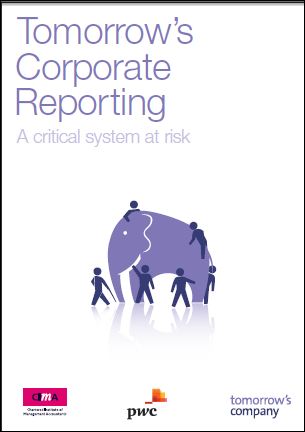
Corporate reporting matters: it plays an essential role in the effective functioning of the market economy. It should make an important contribution to our understanding of, and respect for, business and the financial sector as creators of value by explaining what drives that value now and in the future. The Chartered Institute of Management Accountants (CIMA), PricewaterhouseCoopers and Tomorrow’s Company set up a global study to explore the barriers to the effective development of corporate reporting and the report summarizing the research has now been published. The report explains the findings from the perspective of a number of market participants – companies, auditors, shareholders, investors, standard setters and regulators. Looking forward the research team has also set out the key principles of an agenda for debate and a roadmap for change in the corporate reporting system. (Visit the CIMA website and download Tomorrow’s corporate reporting – a critical system at risk.)

Monday, May 16, 2011

Defined benefit pensions at tipping point

A new survey of more than 150 Canadian pension plan sponsors from professional services firm Towers Watson indicates that just over half (51%) of the private sector defined benefit (DB) plan respondents have now converted their plans to defined contribution (DC) arrangements for current or future employees - up from 42% in 2008. The survey also reveals that recent improvements in economic conditions have had virtually no impact on executives’ perception of a DB funding crisis. The percentage of respondents who agree there is a pension funding crisis has remained at historic highs since the financial downturn of 2008. The survey found that more than half of respondents (56%) believe that the funding crisis will persist for the long term, compared with 34% who held this view in 2008 before the recession. Just under one third (32%) perceive funding challenges to be a cyclical phenomenon. (Read the article “Definedbenefit pensions at tipping point” at Towers Watson online.)