The International Integrated Reporting Council (IIRC) has published the responses to its Discussion Paper, Towards Integrated Reporting – Communicating Value in the 21st Century. More than 215 responses submitted to the IIRC are available online, alphabetically, through the drop-down menu under the green Discussion Paper tab. The IIRC plans to publish a summary of comments by the end of March 2012.
So far, 61 companies have agreed to participate in the Pilot Program to test a new integrated reporting framework as it is developed. There are still opportunities to participate in the Program, especially for companies in North America, South America and Asia. The IIRC is also establishing an Investor Network, which will help shape integrated reporting to meet investors' needs.
Nick Ridehalgh, a senior director with KPMG, says integrated reporting is a chance for CFOs to drive change management by showing they understand the short-term, medium-term and long-term goals of the business and communicate better with the capital markets. Watch the video “Why adopt integrated reporting?” at The Australian Financial Review online.
In addition, PwC in the UK recorded a live webcast called “Business reporting in this economic environment: What to action now and consider for the year ahead” to help identify what makes good reporting. The live webcast aims to share insights on issues for management and the board, to explain what investors want to see in the annual report, and to look ahead at what is likely to change.
With market confidence shaken, there has been a positive response from investors and regulators to those companies that provide some additional, pertinent disclosures to help reassure the markets. This means demonstrating that the critical business issues, such as securing funding for borrowings, acquisitions or capital projects, are being effectively managed. It means inspiring confidence in the business model and its resilience in this economic environment. And, it means building trust in the appropriate governance of the business. The webcast looks at some of the important issues that the board and audit committees are focusing on as they sign off on annual reports.
Showing posts with label investors. Show all posts
Monday, February 27, 2012
Update and Current Perspectives on Integrated Business Reporting
Tuesday, January 17, 2012
AICPA Encourages IIRC to Leverage Enhanced Business Reporting Framework
In a December 14, 2011 comment letter to the International Integrated Reporting Council on its discussion paper, Towards Integrated Reporting: Communicating Value in the 21st Century, the American Institute of Certified Public Accountants (AICPA) supported an international framework for integrated reporting and encouraged the IIRC to leverage the preliminary, high level Enhanced Business Reporting Framework.
The letter states that: “We agree that there is a need for a new reporting model that brings together the currently disparate pieces and perspectives of business reporting to produce a more holistic external presentation of decision-useful information for investors and other stakeholders.” It suggests that the framework should allow organizations to find and report common framework elements most relevant to their stakeholders and that the elements should be presented so that they are comparable across companies and time periods. In order to improve transparency and provide easy access to, and analysis of, integrated reporting disclosures, the framework should allow the creation of standardized integrated reports using data standards such as eXtensible Business Reporting Language (XBRL).
According to the AICPA, the initial focus of integrated reporting should be on larger companies and the needs of their investors, which would serve as an important core foundation that can be leveraged over time to meet the needs of all companies and audiences. For more information, read the AICPA Insight blog and visit the Enhanced Business Reporting section on AICPA.org.
Wednesday, November 2, 2011
Corporate reporting - From compliance to competitive edge
Today’s business information and reporting is under fire from companies, investors, government and regulators alike. In response, PricewaterhouseCoopers (PwC) has published a paper called "Corporate reporting - From Compliance to Competitive Edge" which explains why today's business information and reporting is falling short, what's driving change, where insight is missing and how companies can take action. This report incorporates some of the findings from the PwC annual survey of the quality of FTSE 350 reporting.
(For more information on recent developments, visit the PwC corporate reporting website and also see the PwC Corporate Reporting Blog by David Phillips, Senior Corporate Reporting Partner in the Assurance practice of PricewaterhouseCoopers LLP.)
Tuesday, October 25, 2011
What makes a good annual report?
What’s the secret for a good annual report? It usually boils down to keeping things simple, but keeping them simple these days is a challenge. Rising demands for more disclosure and the integration of sustainability reporting are factors making annual reports ever longer and more complex. Unfortunately, too many annual reports are choked with low-quality information, disconnected content and boilerplate, all of which obscures key messages.
Clear, crisp communication, on the other hand, is a sign of strong leadership. It’s also an opportunity to improve engagement and dialogue with stakeholders. Four techniques for creating a good annual report are: (1) focus on strategy; (2) cut the clutter; (3) sum it up; and (4) speak plainly.
(To learn more, read “What makes a good annual report?” by Richard Ketchen at IR Web Report online.)
Tuesday, October 18, 2011
Canadian Standards in Transition - ASPE Resources Available
The Canadian Institute of Chartered Accountants (CICA) has recently issued three new resources to help private companies make a smooth transition to the new accounting standards for private enterprises (ASPE).
A Guide to Understanding Transitional Options and Accounting Policy Choices
This guide helps practitioners understand the choices and decisions available under the new accounting standards for private enterprises (ASPE) and provides practical examples and worksheets.
A Case Study: Financial Statement Comparison
This publication presents an example of non-consolidated and consolidated financial statements prepared in accordance with pre-changeover accounting standards - XFI Version, and financial statements restated in accordance with ASPE.
Transition Considerations for a Non-Complex Entity
This summary highlights significant changes in the new standards as well as items that require management consideration. The information, geared to non-complex entities, raises awareness for typical balances on a set of financial statements.
A Guide to Understanding Transitional Options and Accounting Policy Choices
This guide helps practitioners understand the choices and decisions available under the new accounting standards for private enterprises (ASPE) and provides practical examples and worksheets.
A Case Study: Financial Statement Comparison
This publication presents an example of non-consolidated and consolidated financial statements prepared in accordance with pre-changeover accounting standards - XFI Version, and financial statements restated in accordance with ASPE.
Transition Considerations for a Non-Complex Entity
This summary highlights significant changes in the new standards as well as items that require management consideration. The information, geared to non-complex entities, raises awareness for typical balances on a set of financial statements.
Thursday, October 13, 2011
Amsterdam Roundtable on Integrated Reporting
An Executive Roundtable on Integrated Reporting was recently organized by the International Integrated Reporting Committee (IIRC) and Duisenberg School of Finance in Amsterdam. It was one of a series of roundtables hosted around the world to encourage the exchange of views on Integrated Reporting among leaders in business, investment, civil society, accounting and the standard setting community. The focus was on the Integrated Reporting Discussion Paper, Towards Integrated Reporting – Communicating Value in the 21st Century, which was launched on September 12, 2011.
It was noted that Integrated Reporting is about accountability regarding past financial and non-financial performance and providing insight in how a company aims to create and sustain value for shareholders and other stakeholders. Integrated Reporting only makes sense if it is part of an integrated business strategy. It should not be a data collection exercise, just for the sake of reporting. In addition, legislation has a role to play in creating a level playing field for Integrated Reporting. It should avoid being compliance based and rather be designed along the lines of a “comply or explain” approach. A Summary of the Roundtable Discussion is available online.
Tuesday, September 27, 2011
XBRL International Conference – October 2011
XBRL (eXtensible Business Reporting Language) is transforming business reporting. Does your company seek recognition as a thought leader on XBRL? If you have business interests or plans for business development, do not miss this opportunity to take the stage! The 23rd XBRL International Conference: "XBRL23: Enhancing Business Performance" is produced by XBRL International, Inc. and hosted by XBRL Canada. The Conference will be held on October 25-27, 2011 at Le Centre Sheraton, Montreal, Canada.
XBRL is an XML-based, royalty-free, open standard for business reporting. XBRL was developed by XBRL International, a not-for-profit consortium of leading companies and organisations around the world. For more information about the XBRL standard, visit the XBRL International website. XBRL Canada conducts seminars and webinars for companies and individuals wishing to learn more about XBRL. Currently, it is also working on projects to assist companies with convergence to IFRS.
Thursday, September 15, 2011
The World is Changing – Reporting Must Too
The Integrated Reporting Discussion Paper, Towards Integrated Reporting – Communicating Value in the 21st Century was launched on September 12, 2011. It is available for reading online and as a PDF document. The Paper considers the rationale for Integrated Reporting, offering initial proposals for the development of an International Integrated Reporting Framework and outlining the next steps towards its creation and adoption. Its purpose is to prompt input from all those with a stake in improved reporting, including producers and users of reports. The International Integrated Reporting Committee (IIRC) welcomes general comments on the Discussion Paper, as well as responses to the questions posed. The deadline for submission is December 14, 2011.
Thursday, July 21, 2011
More evidence that few read annual reports
A new survey of Canadian online investors shows that few rely on formal disclosure documents like annual reports for investment information, even though most describe themselves as long-term investors. The findings of the latest RBC Direct Investing poll of 630 online investors once again highlights the need for companies and their regulators to rethink the role annual reports and prospectuses play in investor relations and financial disclosure programs. The results of this survey echo findings in a range of other investor surveys going back several years. All show that few investors use corporate annual reports and formal disclosure documents – and those who do consult them do so only briefly. (Read the full story by Dominic Jones at IR Web Report.)
Tuesday, July 5, 2011
About the National Investor Relations Institute (NIRI)
Founded in 1969, the National Investor Relations Institute (NIRI) is the professional association of corporate officers and investor relations consultants responsible for communication among corporate management, shareholders, securities analysts and other financial community constituents. The largest professional investor relations association in the world, NIRI’s more than 3,500 members represent 2,000 publicly held companies and $5.4 trillion in stock market capitalization. Investor relations is a strategic management responsibility that integrates finance, communication, marketing and securities law compliance to enable the most effective two-way communication between a company, the financial community, and other constituencies, which ultimately contributes to a company's securities achieving fair valuation. (See IR Weekly and the President's Blog for the latest news and developments in investor relations.)
Wednesday, May 25, 2011
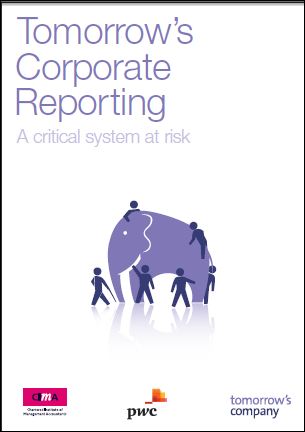
Tomorrow’s corporate reporting – a critical system at risk
Corporate reporting matters: it plays an essential role in the effective functioning of the market economy. It should make an important contribution to our understanding of, and respect for, business and the financial sector as creators of value by explaining what drives that value now and in the future. The Chartered Institute of Management Accountants (CIMA), PricewaterhouseCoopers and Tomorrow’s Company set up a global study to explore the barriers to the effective development of corporate reporting and the report summarizing the research has now been published. The report explains the findings from the perspective of a number of market participants – companies, auditors, shareholders, investors, standard setters and regulators. Looking forward the research team has also set out the key principles of an agenda for debate and a roadmap for change in the corporate reporting system. (Visit the CIMA website and download Tomorrow’s corporate reporting – a critical system at risk.)
Friday, May 13, 2011
Investors spend just 5 minutes on annual reports, according to the stats
“WEB traffic statistics compiled by Google show that investors are spending less than 5 minutes viewing annual meeting materials hosted by large vendors – and younger investors are almost entirely ignoring the documents. The statistics, which aggregate traffic to hundreds of online annual reports and proxy statements hosted by large vendors such as Thomson Reuters, Broadridge Financial Solutions and Computershare, suggest that companies’ disclosure documents are failing to hold the interest of web users, particularly younger users between the ages of 18 and 34 who have grown up with the web. Further evidence of a lack of investor interest in online annual reporting information is provided by statistics compiled using PostRank. They show little or no interest in company annual reports among users of social networking websites, as measured by the number of times they share links to online annual reports.” (Read the full article “Investors spend just 5 minutes on annual reports – stats” by Dominic Jones at IR Web Report online.
Friday, April 29, 2011
Social media investor relations reaches tipping point
According to a recent post on IR Web Report, "IT HAS become a tradition of sorts that quarterly earnings season kicks off when aluminum giant Alcoa Inc. (NYSE:AA) reports its results. ...when the company announced its results, much of the activity and evident investor interest took place outside of the company’s usual channels, on its social media and document sharing accounts. While this might once have seemed remarkable, it’s now fast becoming standard practice for scores of companies – and many more will likely join the parade in the coming weeks."
"In fact, company disclosure channels that once seemed innovative – such as investor relations websites, webcasting and PR wire services – are struggling to stay relevant as investors grow accustomed to receiving information from companies in real-time on their favorite social networks in formats that are easier to access and use. These changes are irreversible and were very much in evidence as Alcoa posted its numbers this week. ...I can’t say this loud enough: SOCIAL MEDIA IS NOW MAINSTREAM, and companies that haven’t yet started using social media in their IR programs are in danger of finding themselves talking to increasingly smaller audiences. We have reached the tipping point for social media in investor relations. If you’re not using social media in your IR program yet, you need to make it a priority and start right away." (Read the full article "Social media investor relations reaches tipping point" by Dominic Jones at IR Web Report online.
Wednesday, April 6, 2011
FEE Factsheet on Integrated Reporting
Debates and developments around the concept of “integrated reporting” are growing in importance. According to the FEE (Fédération des Experts-comptables Européens - Federation of European Accountants), “integrated reporting is a holistic approach to enable investors and other stakeholders to understand how an organisation is really performing. Addressing the wider as well as longer-term consequences of decisions and actions, an integrated report makes clear the link between financial and non-financial value. The relationship between an organisation's strategy, governance and business model should be transparent through such reporting. It also gives an analysis of the impacts and interconnections of material opportunities, risks and performance across the value chain.” The FEE represents 45 professional institutes of accountants and auditors from 33 European countries, including all 27 EU Member States. (Read the FEE Factsheet on Integrated Reporting.
Wednesday, February 2, 2011
Integrated Reporting – Understanding the requirements
KPMG (South Africa) has published a short guidance booklet on Integrated Reporting – Understanding the requirements. It states that "the trend in sustainability reporting has evolved from a corporate responsibility or ethical perspective to one of long-term risk management and value creation. The core concepts revolve around an inclusive approach and integrated reporting to provide a holistic and forward-looking picture of the reporting organization to the multitude of stakeholders who are impacted by and who in turn impact the reporting organization." The guidance includes an “Integrated Reporting Road Map” that contains four phases and 11 steps to consider.
Monday, January 31, 2011
Framework for Integrated Reporting and the Integrated Report
The Integrated Reporting Committee (IRC) of South Africa has recently released a Discussion Paper on the Framework for Integrated Reporting and the Integrated Report (January 25, 2011). The Paper notes that “integrated reporting is a journey. Organizations are unlikely to achieve perfection in the first year. However, as reporting processes for the production of the supporting information are designed and improved and as the executive team begins to benefit from a more informed implementation of the governing structure’s decisions, reporting will improve. Interactive communication with key stakeholders is fundamental to the success of integrated reporting as engagement leads to knowledge of the stakeholders’ legitimate interests and expectations.” Public comments are requested no later than April 25, 2011 (ircomments@saica.co.za). To learn more, read the IRC Media Release.
Friday, January 28, 2011
International Integrated Reporting Committee (IIRC) Newsletter
The International Integrated Reporting Committee (IIRC) is in the process of creating a globally accepted Integrated Reporting framework. A Discussion Paper and five regional roundtables are the first steps on the road to presenting proposals for the framework at the time of the G20 meeting in November 2011. Read more in the IIRC newsletter and subscribe online.
Monday, January 24, 2011
Financial Reporting in Canada under IFRS - First-time Adoption of IFRS
The move to International Financial Reporting Standards (IFRS) is a major challenge for everyone involved in financial reporting in Canada: preparers, users, practitioners, professors and students. The CICA Guidance and Support Group have prepared the 2011 edition of Financial Reporting in Canada under IFRS as a primer for understanding and applying IFRS. Chapter 20 of the publication provides guidance on the First-time Adoption of IFRS. Additional resources are available on the CICA’s Transition to IFRS website.
Wednesday, December 22, 2010
Using the Internet in Corporate Reporting - A New CICA Research Report (Part 4)
In the CICA research report, Using the Internet in Corporate Reporting: Practical Guidance for Effective Communications with Stakeholders, the study group concludes that “The key to integrated reporting is Internet utilization serving as a platform to provide more detailed data than what is available only in hardcopy. In leveraging the Internet, users gain the ability to perform their own analysis of financial and non-financial data, as well as communicate their thoughts and opinions with investors and other stakeholders.” The study group is encouraged by the recent creation of an International Integrated Reporting Committee (IIRC). The IIRC comprises members such as the International Accounting Standards Board, the International Federation of Accountants, the Big Four public accounting firms and some of the world’s largest institutional investors and governance organizations. It will oversee the development of an integrated model for reporting on strategy, risk, governance, financial performance and sustainability. Accordingly, the study group recommends that the CICA collaborate with other accounting bodies in the Global Accounting Alliance to spark global innovation on using the Internet in integrated corporate reporting. This is Part 4 of a multi-part series on the key messages contained in this new CICA research report (also refer to Part 1, Part 2 and Part 3).
Subscribe to:
Posts (Atom)