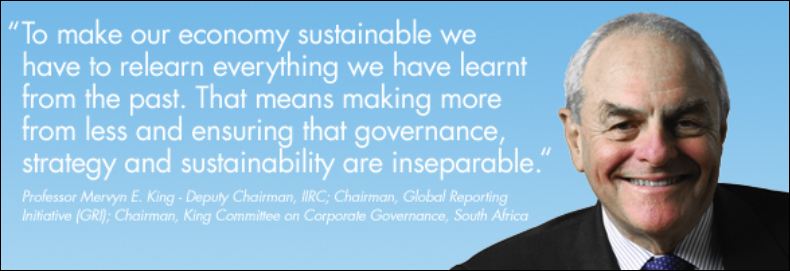
On November 15, 2011, the AICPA organized a roundtable discussion in California on behalf of the International Integrated Reporting Council (IIRC). Major investors, companies and other stakeholders had the opportunity to discuss the business case for integrated reporting, as well as the challenges in communicating the benefits. Why should CFOs care about integrated reporting? Because it’s about: 1. Communicating vs. Complying; 2. Reporting the Intangibles; 3. Breaking Down Silos; and 4. Increasing Transparency.
To learn more, refer to the article “4 Reasons CFOs Should Care about Integrated Reporting” at AICPA Insights online.
Showing posts with label non-financial information. Show all posts
Friday, January 27, 2012
Tuesday, October 18, 2011
Canadian Standards in Transition - ASPE Resources Available
The Canadian Institute of Chartered Accountants (CICA) has recently issued three new resources to help private companies make a smooth transition to the new accounting standards for private enterprises (ASPE).
A Guide to Understanding Transitional Options and Accounting Policy Choices
This guide helps practitioners understand the choices and decisions available under the new accounting standards for private enterprises (ASPE) and provides practical examples and worksheets.
A Case Study: Financial Statement Comparison
This publication presents an example of non-consolidated and consolidated financial statements prepared in accordance with pre-changeover accounting standards - XFI Version, and financial statements restated in accordance with ASPE.
Transition Considerations for a Non-Complex Entity
This summary highlights significant changes in the new standards as well as items that require management consideration. The information, geared to non-complex entities, raises awareness for typical balances on a set of financial statements.
A Guide to Understanding Transitional Options and Accounting Policy Choices
This guide helps practitioners understand the choices and decisions available under the new accounting standards for private enterprises (ASPE) and provides practical examples and worksheets.
A Case Study: Financial Statement Comparison
This publication presents an example of non-consolidated and consolidated financial statements prepared in accordance with pre-changeover accounting standards - XFI Version, and financial statements restated in accordance with ASPE.
Transition Considerations for a Non-Complex Entity
This summary highlights significant changes in the new standards as well as items that require management consideration. The information, geared to non-complex entities, raises awareness for typical balances on a set of financial statements.
Thursday, October 13, 2011
Amsterdam Roundtable on Integrated Reporting
An Executive Roundtable on Integrated Reporting was recently organized by the International Integrated Reporting Committee (IIRC) and Duisenberg School of Finance in Amsterdam. It was one of a series of roundtables hosted around the world to encourage the exchange of views on Integrated Reporting among leaders in business, investment, civil society, accounting and the standard setting community. The focus was on the Integrated Reporting Discussion Paper, Towards Integrated Reporting – Communicating Value in the 21st Century, which was launched on September 12, 2011.
It was noted that Integrated Reporting is about accountability regarding past financial and non-financial performance and providing insight in how a company aims to create and sustain value for shareholders and other stakeholders. Integrated Reporting only makes sense if it is part of an integrated business strategy. It should not be a data collection exercise, just for the sake of reporting. In addition, legislation has a role to play in creating a level playing field for Integrated Reporting. It should avoid being compliance based and rather be designed along the lines of a “comply or explain” approach. A Summary of the Roundtable Discussion is available online.
Friday, August 19, 2011
CICA Financial Reporting and Accounting Conference (IFRS and ASPE)
The Canadian Institute of Chartered Accountants (CICA) is presenting its annual Financial Reporting and Accounting Conference on September 26-27, 2011 (optional workshops, September 28) at the Metro Toronto Convention Centre in Toronto, Canada. This conference is Canada’s leading financial reporting and accounting event and provides an up-to-date and extensive review of the most critical current and emerging issues facing both publicly-traded and privately-held corporations in Canada. Extensive coverage of the latest developments in both International Financial Reporting Standards (IFRS) and Accounting Standards for Private Enterprises (ASPE) will be delivered by prominent Canadian, US and international speakers. In-depth workshops addressing the most relevant and challenging financial reporting topics will also be available. (For more information on CICA Continuing Education products, visit the online CA Learning Centre.)
Monday, May 9, 2011
That's Summa Story - From the Caves to Cafe Pacioli
Accountants are generally recognized as making a valuable contribution to society, by providing the information that allows entrepreneurship to flourish, business to operate efficiently, stakeholders’ interests to be protected, shares to be fairly priced, and taxation and audit requirements to be satisfied. Accounting, however, has not always enjoyed such an established position, and today there is often a tendency to take the profession’s status for granted. It is interesting, therefore, to examine the factors that have brought accounting to the preeminent place that it occupies today.To learn more about the history of accounting, read the article "That's Summa Story! From the Caves to Café Pacioli" by Derry Cotter, FCA. To access the full text of this article, see the Digital Edition of Accountancy Ireland, February 2011, (pages 50-53).

Friday, May 6, 2011
Using electronic communications between CA firms and clients
Almost all CA firms are communicating at least some information to their clients electronically, according to the CICA’s most recent Managing a Public Practice (MAPP) survey on computerization. Nearly all firms represented in the survey send e-mails (99%), PDFs (96%) and other correspondence (93%) to their clients electronically. Four out of five firms (80%) send corporate tax returns to clients electronically. Personal tax returns (82%) and financial statements (87%) are also sent electronically by more than 80% of firms. The results are from a broader three-part MAPP CA practice benchmark survey conducted biannually with the partners of CA firms across Canada. (Read the article “Electronic Update” at CAmagazine online.)
Monday, April 18, 2011
Canadian regulator issues guides on IFRS
The Ontario Securities Commission (OSC) has issued two high-level guides on the impacts of IFRS: Deciphering IFRS - What Analysts Need To Know About IFRS Transition and Investing in the New Era - What Investors Need To Know About IFRS Transition. The guides outline a number of questions for analysts and investors to consider and are available on the OSC website.
Wednesday, April 13, 2011
Integrated Reporting Workshop Videos - Harvard Business School
A series of about 30 YouTube videos has recently been posted by the Harvard Business School. The videos cover the various speaker presentations at the Workshop on Integrated Reporting which was held at the Harvard Business School on October 14-15, 2010. The Workhop was discussed in a previous blog posting on December 1, 2010.
Wednesday, April 6, 2011
FEE Factsheet on Integrated Reporting
Debates and developments around the concept of “integrated reporting” are growing in importance. According to the FEE (Fédération des Experts-comptables Européens - Federation of European Accountants), “integrated reporting is a holistic approach to enable investors and other stakeholders to understand how an organisation is really performing. Addressing the wider as well as longer-term consequences of decisions and actions, an integrated report makes clear the link between financial and non-financial value. The relationship between an organisation's strategy, governance and business model should be transparent through such reporting. It also gives an analysis of the impacts and interconnections of material opportunities, risks and performance across the value chain.” The FEE represents 45 professional institutes of accountants and auditors from 33 European countries, including all 27 EU Member States. (Read the FEE Factsheet on Integrated Reporting.
Wednesday, December 1, 2010
A Workshop on Integrated Reporting: Frameworks and Action Plan
On October 14-15, 2010, “A Workshop on Integrated Reporting: Frameworks and Action Plan” was held at the Harvard Business School. The workshop was sponsored by the Business & Environment Initiative. Robert G. Eccles was the workshop chairman. For two days, over 100 of the world’s leading authorities on corporate disclosure discussed the concept of integrated reporting, what its contribution could be to creating a more sustainable society, and what must be done to ensure its rapid and broad adoption in a high quality way. The workshop participants included people from a wide range of countries and representing virtually every group that has a stake in integrated reporting and can help to make it happen: companies, analysts and investors, NGOs, regulators and standard setters, accounting firms, technology and data vendors, academics, students and civil society. An Executive Summary of the workshop is available online, as well as a compilation of the workshop papers, The Landscape of Integrated Reporting: Reflections and Next Steps.
Friday, November 12, 2010
NYSE issues report on core governance principles
The New York Stock Exchange's Commission on Corporate Governance has released a report that identified core governance principles it believed could be widely accepted and supported by issuers, investors, directors and other market participants. The Commission, formed in response to the financial crisis of 2008 and 2009, considered numerous issues, including the proper role and scope of a director's authority, management's responsibility for governance and the relationship between a shareholder's trading activities, voting decisions and governance.
Monday, March 15, 2010
UK - Developments in New Reporting Models
The Institute of Chartered Accountants in England and Wales (ICAEW) has published Developments in New Reporting Models. The report argues that business reporting must reflect changes in business, in information technology and in user needs. The debate on the future of business reporting needs to be reframed in terms of continuing evolutionary improvements. Copyrighted by ICAEW, the report is posted on Deloitte IAS Plus with permission of the ICAEW Financial Reporting Faculty.
Friday, January 22, 2010
US - SEC financial reporting issues facing smaller companies
During 2009 the US Public Company Accounting Oversight Board (PCAOB) hosted a series of Forums on Auditing in the Small Business Environment. At those Forums, the staff of the Division of Corporation Finance of the Securities and Exchange Commission (SEC) reviewed common financial reporting issues identified during their staff reviews of filings for smaller public companies. (View the SEC Staff Review of Common Financial Reporting Issues Facing Smaller Issuers (December 2009) and other SEC information for small businesses.)
Wednesday, January 20, 2010
US - SEC guidance on non-GAAP financial measures
The US Securities and Exchange Commission (SEC) staff has issued Compliance and Disclosure Interpretations (C&DIs) on disclosure of non-GAAP financial measures. Among other things, the new guidance clarifies that the SEC does not discourage registrants from disclosing non-GAAP financial measures in filings with the SEC. For example, one of the new Q&A clarifies that there is no prohibition against disclosing a non-GAAP financial measure that is not used by management in managing its business. (Read the SEC Guidance on Non-GAAP Financial Measures issued on January 15, 2010.)
Saturday, September 12, 2009
Corporate reporting - Good practice examples
PricewaterhouseCoopers (PwC) has prepared a catalogue that contains examples of good practice in corporate reporting. Each example is accompanied by an introduction explaining why the example was chosen, as well as a detailed commentary from experts based on the PwC corporate reporting framework. The examples can be searched by industry, company name, country and category or element of the corporate reporting framework. In addition, the examples can be downloaded and printed in PDF format. (Visit the PwC corporate reporting webpage for more information.)
Monday, August 17, 2009
Updated SEC Financial Reporting Manual
The US Securities and Exchange Commission (SEC) Division of Corporation Finance has updated its Financial Reporting Manual. This 323-page manual is an informal reference document for SEC staff and provides general guidance only. The SEC has made it available on its public website. Topics include: Registrant's financial statements; Other financial statements required; Pro forma financial information; Independent accountant's involvement; Smaller reporting companies; Foreign private issuers & foreign businesses; Related party matters; Non-GAAP measures of financial performance, liquidity and net worth; Management's discussion and analysis of financial position and results of operations (MD&A); Reverse acquisitions and reverse recapitalizations; Effects of subsequent events on financial statements required in filings; Tender offers; Employee stock benefit plans; and Multijurisdictional disclosure system. (Read the Updated SEC Financial Reporting Manual or review the contents online.)
Tuesday, March 24, 2009
ICGN - Guidance on Non-financial Business Reporting
The International Corporate Governance Network (ICGN) has published a Statement and Guidance on Non-financial Business Reporting to emphasize its importance within the overall context of company reporting and to promote better understanding by setting out disclosure criteria that will assist companies in meeting the expectations of investors. As such, the ICGN Statement and Guidance aims to generate substantive dialogue between investors and company boards about the content and timing of non-financial business reporting.
Friday, November 21, 2008
Open communications during IFRS transition process
In 2011, Canada will adopt International Financial Reporting Standards (IFRS) when Canadian Generally Accepted Accounting Principles (GAAP) for publicly-accountable enterprises migrate to IFRS. Companies need to tailor communications to stakeholders about the particular challenges that IFRS conversion presents. The Canadian Institute of Chartered Accountants (CICA) is providing guidance on how to provide useful information to investors in the period leading up to the changeover through a new publication titled: Pre-2011 Communications About IFRS Conversion.
Tuesday, November 4, 2008
IR Global Rankings
The IR Global Rankings is a comprehensive ranking system for IR website, corporate governance practices and financial disclosure procedures. Based on extensive proprietary research of public companies and investors, the methodology is detailed, transparent and completely accessible to all participants. The IR Global Rankings, supported by KPMG, Demarest & Almeida, Corporate Asia Network and Arnold & Porter, is a unique external review of any company’s communication process with analysts and investors worldwide.
Thursday, October 23, 2008
Global framework for communicating non-financial information
A new framework has been developed by the World Intellectual Capital Initiative (WICI) to improve communications between a company and its stakeholders about the nonfinancial factors contributing to its market value. WICI is a global business reporting network of public-sector and private-sector interests, of which the American Institute of Certified Public Accountants (AICPA) is a member through the Enhanced Business Reporting Consortium. WICI has also developed an eXtensible Business Reporting Language (XBRL) taxonomy to support the framework, which considers business strategy, personnel, research and development, customer base and other nontangible factors as part of business reporting. Read the AICPA's news release and view the WICI presentation.
Subscribe to:
Posts (Atom)