Showing posts with label investor information. Show all posts
Wednesday, January 11, 2012
Canada’s Corporate Reporting Awards program celebrates 60 years of excellence
For 60 years, the CRA has been Canada’s only national program shining a spotlight on Canada’s best corporate reporting models. The program offers publicly-listed companies, and now federal and provincial Crown corporations, a unique opportunity to showcase their commitment to quality corporate reporting. Entrants demonstrate confidence in their reports by submitting them to an independent panel of judges, who are experts in their respective areas.
Fifteen Canadian publicly-listed companies and Crown corporations were recently honoured in Toronto at a gala event that marked the diamond anniversary of the Chartered Accountants of Canada’s Corporate Reporting Awards (CRA).
When the program started in 1941, the focus was the annual financial report. Over the years, it has evolved to keep pace with the capital markets and the expectations of Canadian investors for greater transparency and better information on which to base their investment decisions. Today’s CRA includes separate categories for corporate governance reporting, sustainable development reporting and electronic disclosure. The criteria have helped drive the development of best practices in all these areas, which are now regarded as essential components of the integrated corporate reporting model.
Tuesday, October 18, 2011
Canadian Standards in Transition - ASPE Resources Available
The Canadian Institute of Chartered Accountants (CICA) has recently issued three new resources to help private companies make a smooth transition to the new accounting standards for private enterprises (ASPE).
A Guide to Understanding Transitional Options and Accounting Policy Choices
This guide helps practitioners understand the choices and decisions available under the new accounting standards for private enterprises (ASPE) and provides practical examples and worksheets.
A Case Study: Financial Statement Comparison
This publication presents an example of non-consolidated and consolidated financial statements prepared in accordance with pre-changeover accounting standards - XFI Version, and financial statements restated in accordance with ASPE.
Transition Considerations for a Non-Complex Entity
This summary highlights significant changes in the new standards as well as items that require management consideration. The information, geared to non-complex entities, raises awareness for typical balances on a set of financial statements.
A Guide to Understanding Transitional Options and Accounting Policy Choices
This guide helps practitioners understand the choices and decisions available under the new accounting standards for private enterprises (ASPE) and provides practical examples and worksheets.
A Case Study: Financial Statement Comparison
This publication presents an example of non-consolidated and consolidated financial statements prepared in accordance with pre-changeover accounting standards - XFI Version, and financial statements restated in accordance with ASPE.
Transition Considerations for a Non-Complex Entity
This summary highlights significant changes in the new standards as well as items that require management consideration. The information, geared to non-complex entities, raises awareness for typical balances on a set of financial statements.
Tuesday, September 27, 2011
XBRL International Conference – October 2011
XBRL (eXtensible Business Reporting Language) is transforming business reporting. Does your company seek recognition as a thought leader on XBRL? If you have business interests or plans for business development, do not miss this opportunity to take the stage! The 23rd XBRL International Conference: "XBRL23: Enhancing Business Performance" is produced by XBRL International, Inc. and hosted by XBRL Canada. The Conference will be held on October 25-27, 2011 at Le Centre Sheraton, Montreal, Canada.
XBRL is an XML-based, royalty-free, open standard for business reporting. XBRL was developed by XBRL International, a not-for-profit consortium of leading companies and organisations around the world. For more information about the XBRL standard, visit the XBRL International website. XBRL Canada conducts seminars and webinars for companies and individuals wishing to learn more about XBRL. Currently, it is also working on projects to assist companies with convergence to IFRS.
Tuesday, August 30, 2011
Usefulness of the Independent Auditor’s Report
According to the CFA Institute, there is a growing worldwide debate on the usefulness of the independent auditor’s report. The current “pass/fail” model simply communicates that the financial statements are, in the auditor’s opinion, presented in accordance with generally accepted accounting principles, but there is no information available on how the auditor addressed the risks of material misstatements identified during the audit process. While it is clear that more information about the quality of the financial statements and the audit process might be useful, it is not clear what kind of information should be communicated through the auditor’s reporting model.
The CFA Institute sought feedback on this topic to assist in informing the audit standards-setting bodies as they consider how to modify the Independent Auditor’s Report to ensure that the user needs are being considered in any proposed changes. Survey results show that 58% think that the independent auditor’s report needs to provide more specific information about how the auditors reach their opinion. The most important additional information to include is: information about the independent auditor’s assessment of management’s critical accounting judgments and estimates (86% felt this was important to include); and, information about the independent auditor’s assessment of the quality, not just the acceptability, of management’s selection and application of accounting principles (90% felt this was important to include).
(For more information, read the March 2011 CFA survey report, Usefulness of the Independent Auditor’s Report, available online.)
The CFA Institute sought feedback on this topic to assist in informing the audit standards-setting bodies as they consider how to modify the Independent Auditor’s Report to ensure that the user needs are being considered in any proposed changes. Survey results show that 58% think that the independent auditor’s report needs to provide more specific information about how the auditors reach their opinion. The most important additional information to include is: information about the independent auditor’s assessment of management’s critical accounting judgments and estimates (86% felt this was important to include); and, information about the independent auditor’s assessment of the quality, not just the acceptability, of management’s selection and application of accounting principles (90% felt this was important to include).
(For more information, read the March 2011 CFA survey report, Usefulness of the Independent Auditor’s Report, available online.)
Thursday, August 4, 2011
IFRS: the first quarter
The first IFRS Canadian corporate report filings are now in. How did the implementation go? What went right? What went wrong? What can we expect in the future? With a number of major IFRS projects underway at the International Accounting Standards Board — policy decisions for leases and financial instruments — the new reporting landscape is still a live environment. For a review of how selected companies were able to prepare their first IFRS reports, read the article "IFRS: the first quarter" in the August 2011 issue of CAmagazine online.
Thursday, July 21, 2011
More evidence that few read annual reports
A new survey of Canadian online investors shows that few rely on formal disclosure documents like annual reports for investment information, even though most describe themselves as long-term investors. The findings of the latest RBC Direct Investing poll of 630 online investors once again highlights the need for companies and their regulators to rethink the role annual reports and prospectuses play in investor relations and financial disclosure programs. The results of this survey echo findings in a range of other investor surveys going back several years. All show that few investors use corporate annual reports and formal disclosure documents – and those who do consult them do so only briefly. (Read the full story by Dominic Jones at IR Web Report.)
Tuesday, July 5, 2011
About the National Investor Relations Institute (NIRI)
Founded in 1969, the National Investor Relations Institute (NIRI) is the professional association of corporate officers and investor relations consultants responsible for communication among corporate management, shareholders, securities analysts and other financial community constituents. The largest professional investor relations association in the world, NIRI’s more than 3,500 members represent 2,000 publicly held companies and $5.4 trillion in stock market capitalization. Investor relations is a strategic management responsibility that integrates finance, communication, marketing and securities law compliance to enable the most effective two-way communication between a company, the financial community, and other constituencies, which ultimately contributes to a company's securities achieving fair valuation. (See IR Weekly and the President's Blog for the latest news and developments in investor relations.)
Friday, May 13, 2011
Investors spend just 5 minutes on annual reports, according to the stats
“WEB traffic statistics compiled by Google show that investors are spending less than 5 minutes viewing annual meeting materials hosted by large vendors – and younger investors are almost entirely ignoring the documents. The statistics, which aggregate traffic to hundreds of online annual reports and proxy statements hosted by large vendors such as Thomson Reuters, Broadridge Financial Solutions and Computershare, suggest that companies’ disclosure documents are failing to hold the interest of web users, particularly younger users between the ages of 18 and 34 who have grown up with the web. Further evidence of a lack of investor interest in online annual reporting information is provided by statistics compiled using PostRank. They show little or no interest in company annual reports among users of social networking websites, as measured by the number of times they share links to online annual reports.” (Read the full article “Investors spend just 5 minutes on annual reports – stats” by Dominic Jones at IR Web Report online.
Monday, April 18, 2011
Canadian regulator issues guides on IFRS
The Ontario Securities Commission (OSC) has issued two high-level guides on the impacts of IFRS: Deciphering IFRS - What Analysts Need To Know About IFRS Transition and Investing in the New Era - What Investors Need To Know About IFRS Transition. The guides outline a number of questions for analysts and investors to consider and are available on the OSC website.
Friday, April 15, 2011
CEO Round Table - What do the leaders of the top seven CA firms think about key issues?
In December 2010, Kevin Dancey, president and CEO of the Canadian Institute of Chartered Accountants (CICA), hosted a round table discussion with the CEOs of the top seven accounting firms. The discussion covered a wide range of topics of interest to the profession. Participants included Chris Clark of PricewaterhouseCoopers, Keith Farlinger of BDO Canada, Trent Henry of Ernst & Young, Alan MacGibbon of Deloitte, Phil Noble of Grant Thornton, Daryl Ritchie of Meyers Norris Penny and Bill Thomas of KPMG. Also present was Bill MacKinnon, chairman of the CICA. Read what these leaders had to say about key issues in the article "CEO Round Table" at CAmagazine online.
Monday, March 21, 2011
Estimating the Fair Value of Investments
In September 2006, the US Financial Accounting Standards Board (FASB) issued Statement of Financial Accounting Standards (SFAS) 157, Fair Value Measurements (now Accounting Standards Codification [ASC] section 820-10, Fair Value Measurements and Disclosures), with the stated objective of simplifying the measurement and disclosure of fair value information. The application of this guidance to investments in certain nonpublic entities, such as alternative investments, proved more difficult than originally envisioned. Read the CPA Journal article "Estimating the Fair Value of Investments in Entities that Calculate Net Value Per Share" in digital format.
Wednesday, March 2, 2011
Research on Corporate Disclosures
Why do some companies provide extensive forward-looking disclosures while others remain relatively silent? What prompts some companies to disclose important discretionary information in their letter to shareholders rather than in the management discussion and analysis (MD&A)? Is the extent of disclosure likely to change as companies move to adopt IFRS? Recent developments in academic research help address these and other questions. Literature on voluntary versus mandatory disclosures and a sample of Canadian public companies illustrate the form and content of forward-looking disclosures in Canadian annual reports. Scan the article “Corporate Disclosures” in the March 2010 edition of CAmagazine online and learn more by reading the CICA research study Corporate Reporting to Stakeholders (June 2008).
Wednesday, January 19, 2011
Information overload: The paradox of better business reporting
Corporate reporting faces serious challenges, especially in the financial services sector. Disclosure requirements and best practice have always evolved in response to developing regulation and accounting standards. What is especially disruptive at the moment is that accounting standards and regulation in financial services are changing radically in response to the financial crisis. More and more weight is being loaded onto corporate reporting, but there is a risk that the benefits of progress may be swamped under a mass of detail. Read the article "Information overload: The paradox of better business reporting" in the January 2011 edition of Frontiers in Finance on the KPMG website.
Thursday, January 13, 2011
IIRC Round Table to be hosted in India – January 19, 2011
The first of a series of round table events is to be held on January 19, 2011 at the Hotel Taj President in Mumbai. The International Integrated Reporting Committee (IIRC) Round Table will be part of the “Responsible Investment: Mainstreaming of Environmental, Social, Governance Factors” event hosted by German Development Corporation GTZ and the Global Reporting Initiative focal point in India. Indian stakeholders from the investment, business, financial and sustainability communities will be invited to discuss in groups proposals presented by the IIRC, the key themes around the questions of to what extent would integrated reporting help to incorporate a broader set of factors into investment decision-making and improving the company’s performances and, what are the key barriers to adoption of such a planned framework. Admission to this event is by invitation only. To learn more about the IIRC, read Governance and Collaboration – “Establishing an International Integrated Reporting Committee” published in December 2009 and updated May 2010.
Wednesday, December 1, 2010
A Workshop on Integrated Reporting: Frameworks and Action Plan
On October 14-15, 2010, “A Workshop on Integrated Reporting: Frameworks and Action Plan” was held at the Harvard Business School. The workshop was sponsored by the Business & Environment Initiative. Robert G. Eccles was the workshop chairman. For two days, over 100 of the world’s leading authorities on corporate disclosure discussed the concept of integrated reporting, what its contribution could be to creating a more sustainable society, and what must be done to ensure its rapid and broad adoption in a high quality way. The workshop participants included people from a wide range of countries and representing virtually every group that has a stake in integrated reporting and can help to make it happen: companies, analysts and investors, NGOs, regulators and standard setters, accounting firms, technology and data vendors, academics, students and civil society. An Executive Summary of the workshop is available online, as well as a compilation of the workshop papers, The Landscape of Integrated Reporting: Reflections and Next Steps.
Monday, November 15, 2010
Accounting profession to play key role in integrated reporting
The profession is to play a key role in helping companies report on both financial and non-financial results in the future. The conclusion came as the final session at the World Congress of Accountants discussed the profession's future over the next decade. Reporting that encompasses economic, social and environmental results will become "the norm", according to the International Federation of Accountants (IFAC) chief executive, Ian Ball. (Read the article at Accountancy Age online.)
Friday, November 12, 2010
NYSE issues report on core governance principles
The New York Stock Exchange's Commission on Corporate Governance has released a report that identified core governance principles it believed could be widely accepted and supported by issuers, investors, directors and other market participants. The Commission, formed in response to the financial crisis of 2008 and 2009, considered numerous issues, including the proper role and scope of a director's authority, management's responsibility for governance and the relationship between a shareholder's trading activities, voting decisions and governance.
Thursday, November 11, 2010
Novo Nordisk - Awards and Recognitions
Awards and recognitions can be seen as an indicator of stakeholders' perception of a company based on its activities or the quality of its communications. Such accolades contribute to shaping the company's reputation in the public domain and among key opinion-formers and stakeholders. In 2009, Novo Nordisk received a number of honours and awards relating to its performance and its Triple Bottom Line approach to doing business. For examples of the corporate awards, visit the Novo Nordisk website and view the Novo Nordisk Annual Report 2009.
Wednesday, November 10, 2010
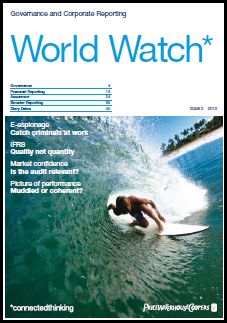
PwC - World Watch: Governance and Corporate Reporting
There is growing recognition of the importance of transparency and common business languages to communicate business information to investors and other stakeholders. This is particularly important in the current business environment. The PricewaterhouseCoopers (PwC) newsletter, World Watch, contains opinion articles, case studies and worldwide news on the many initiatives to improve corporate reporting. (Read the current issue of World Watch on the PwC website.)
Monday, July 26, 2010
CSA - Continuous Disclosure Review Program for March 31, 2010
Canadian Securities Administrators (CSA) have issued Staff Notice 51-332 Continuous Disclosure Review Program Activities for the fiscal year ended March 31, 2010, which summarizes the results of the CSA’s continuous disclosure (CD) review program. The number of reviews (1,351) represents a 23% increase from fiscal 2009 when the CSA conducted 1,094 reviews. The main reason for this increase was the completion of International Financial Reporting Standards (IFRS) transition disclosure reviews. To assist reporting issuers, Staff Notice 51-332 includes detailed examples of the common deficiencies found during the reviews in financial statements, Management’s Discussion and Analysis (MD&A) and oil and gas disclosure.
Subscribe to:
Posts (Atom)